
Imagine for a moment transferring your inner preferences to a simple food choice: your mouth wants a cookie, but your body wants a carrot. It is like two good friends arguing over where to go. One seeks immediate pleasure and rapid comfort, whilst the other looks out for your long-term vitality, your muscles, and your sustained health. To resolve this argument, you do not need to silence either side through harsh force. Instead, you have to become a great listener. You listen to what the carrot will do for your strength and vitality, and you listen to what the cookie is attempting to satisfy in that brief moment.
In therapeutic practice, this internal friction is one of the most common reasons people feel stuck or mentally fatigued.
When you experience an internal dilemma, your conscious mind often becomes a battlefield. One part of you wants to stay safe within established routine, whilst another part longs for change or self-improvement.
Why this happens
Internal conflict occurs because the human brain operates through distinct systems that process needs, rewards, and safety differently. Your subconscious mind is largely programmed to seek immediate security and fast comfort, relying on deeply ingrained habits to conserve energy and reduce stress. Conversely, your analytical executive mind focuses on future goals, personal growth, health, and long-term values.
When a decision arises—whether it involves career changes, lifestyle shifts, or health routines—these two systems frequently offer opposing solutions. The impulse towards immediate comfort is not inherently malicious; it is simply an automatic self-soothing mechanism. However, when short-term comfort repeatedly overrides your long-term intent, you experience emotional fatigue, regret, and doubt.
This dynamic is especially prominent when dealing with habit change, substance reduction, or weight management. The brain naturally resists sudden disruption. When you try to force a decision purely through willpower, you activate inner tension. Understanding that every impulse carries an underlying protective intention allows you to address the root cause rather than fighting yourself.
How to fix it
Resolving a persistent dilemma requires moving from internal conflict to peaceful negotiation. Rather than attempting to suppress your cravings or fears, you learn to observe them with precise, calm attention.
First, acknowledge both sides of the debate. Give the immediate impulse space to be heard without instantly acting upon it or condemning it. Ask yourself what emotional comfort or temporary relief that option is trying to supply. Next, direct your attention to your long-term vision, recognizing how aligned choices build self-trust and physical vitality over time.
Hypnotherapy serves as an effective bridge during this process. In a relaxed, focused state, the subconscious mind becomes receptive to constructive suggestion and perspective shifts.
Your 1-2-3 quick guide
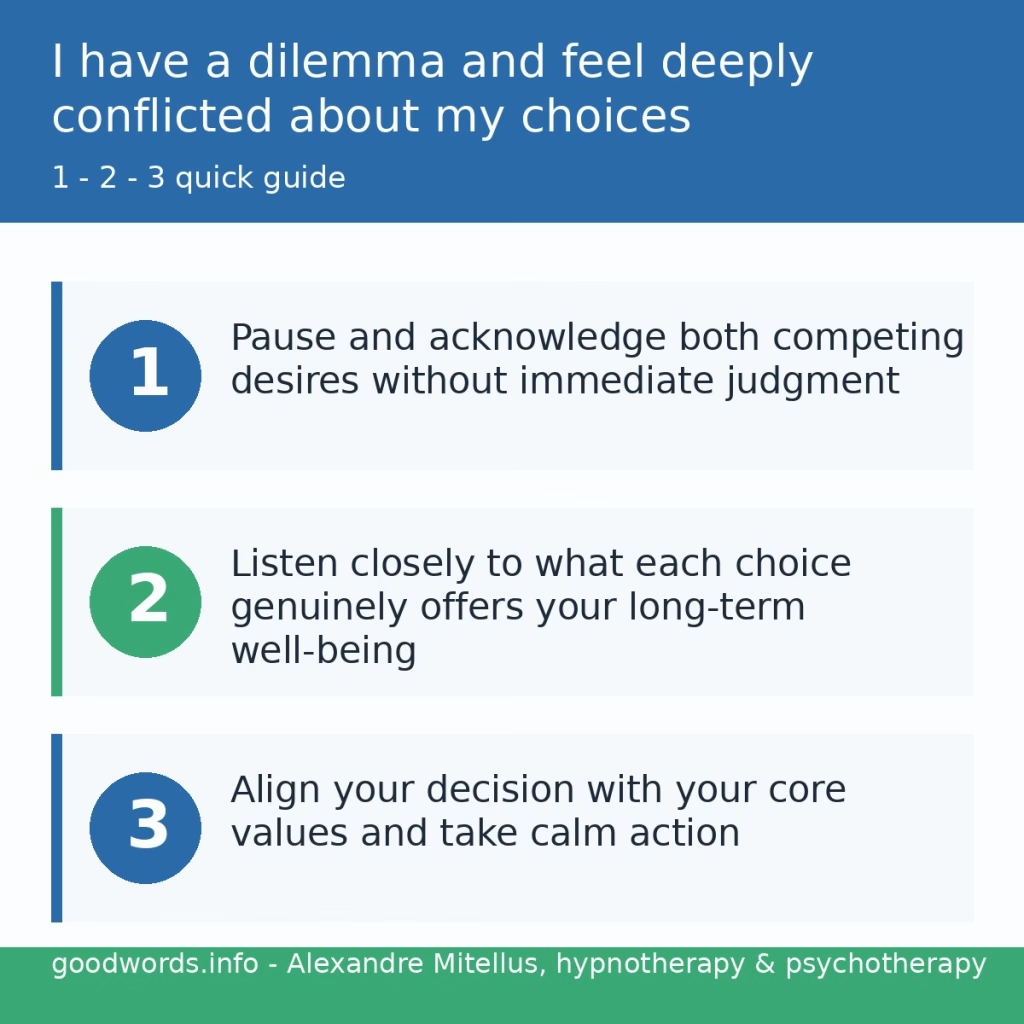
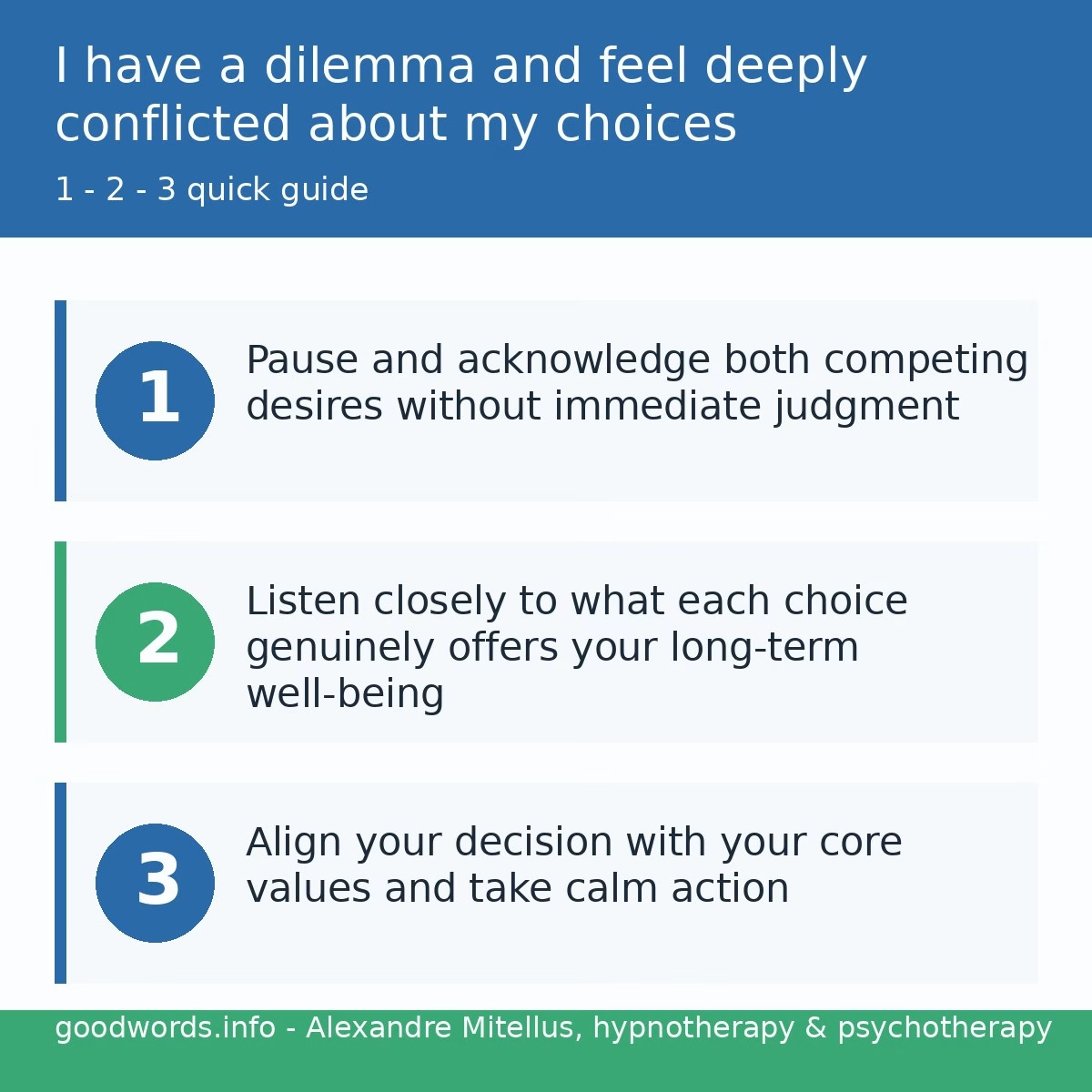
- Pause and acknowledge both competing desires without immediate judgment
- Listen closely to what each choice genuinely offers your long-term well-being
- Align your decision with your core values and take calm action
Hypnotherapy FAQ
What is clinical hypnotherapy and how does it help with decision making?
Clinical hypnotherapy is a safe, evidence-informed practice that uses focused relaxation and guided attention to access the subconscious mind. By reducing mental noise and anxiety, it helps you evaluate complex choices calmly and align your automatic habits with your conscious goals.
Will I lose control or be asleep during a hypnotherapy session?
No, you remain fully conscious, aware, and in complete control throughout the session. Hypnosis is a state of peaceful, heightened focus, similar to being absorbed in a good book, and you can pause or stop the process at any time.
Can everyone be hypnotised to resolve habits or internal conflicts?
Yes, virtually everyone with an open mind and a willingness to follow simple instructions can experience hypnotic trance. The depth of trance varies between individuals, but even light relaxation is effective for achieving clarity and mental alignment.
How many sessions are usually needed to see real progress?
The number of consultations depends on your individual needs and goals. Many clients notice a positive shift in perspective after just two to four sessions, while others benefit from ongoing support or using supplementary relaxation audio programmes between visits.
Are online hypnotherapy sessions across Ireland as effective as in-person visits?
Yes, online sessions delivered via a secure video link are just as effective as clinic consultations in Cork or Dublin. Being in your own comfortable, private environment often helps you settle into deep relaxation more easily.
How is my personal information protected during consultations?
All client sessions, whether online or in person, are held in strict professional confidence. Your personal details and session notes are managed in full compliance with GDPR guidelines, as outlined in our published privacy policy.
Never listen while driving or operating machinery.
I have a dilemma and feel conflicted about my choices
00:00 / 00:00

