
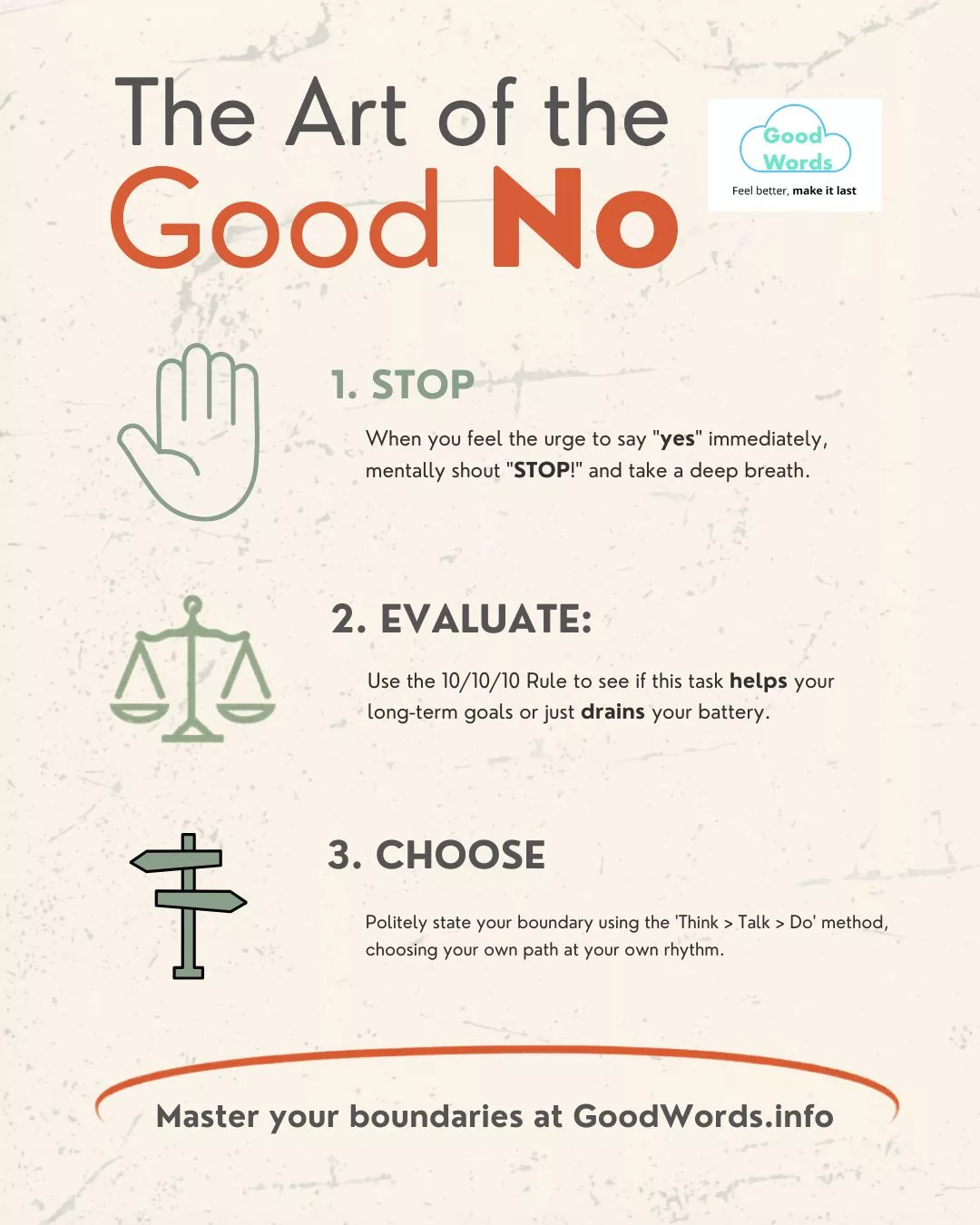
Imagine you are a running on a limited battery. Every time you say “yes” to a new job or a new game, a little bit of your battery goes “zip!” and disappears. If you say “yes” to every single person who asks, your battery will run out, and you’ll go “clunk” and stop moving! Saying “no” is like keeping a little bit of battery for yourself so you can stay a super-strong for the most important games.
Why This Happens: This struggle often comes from a “Fawn” response, a natural survival habit where we try to please others to avoid conflict, isolation and stay safe. Your body’s “engine” aims to naturally reduce effort by following collective group norms rather than facing the “strain” of standing out. You may be relying on “historical conditioned beliefs“ from childhood that say being “good” means being 100% obedient, leading to an unproductive loop of “rust-out” or burnout.
How to Fix It: Use the “10/10/10 Rule” to break the cycle of “Time Distortion” and urgency. When a demand is made, don’t react instantly; instead, ask yourself: “Will this matter in 10 minutes? 10 months? 10 years?”. If it won’t matter in 10 months, use the “Grounding”: pause, breathe, and feel your feet firmly on the floor to ground yourself. This gives you the “Power to Decide” based on your biological needs for recovery, rather than just mental “wants” to please others.
Context Research: British researcher Stephen Williams describes the “Pressure Performance Curve,” noting that while some pressure is a healthy “stretch,” taking on too much leads to “Strain” and “Delusion”. This aligns with Carl Jung’s philosophy that we must find our own “uniqueness” rather than self-sabotaging to fit into a group value. By saying “no,” you are acting as the Architect of your own Balance, ensuring your “engine” stays clean and productive.


