
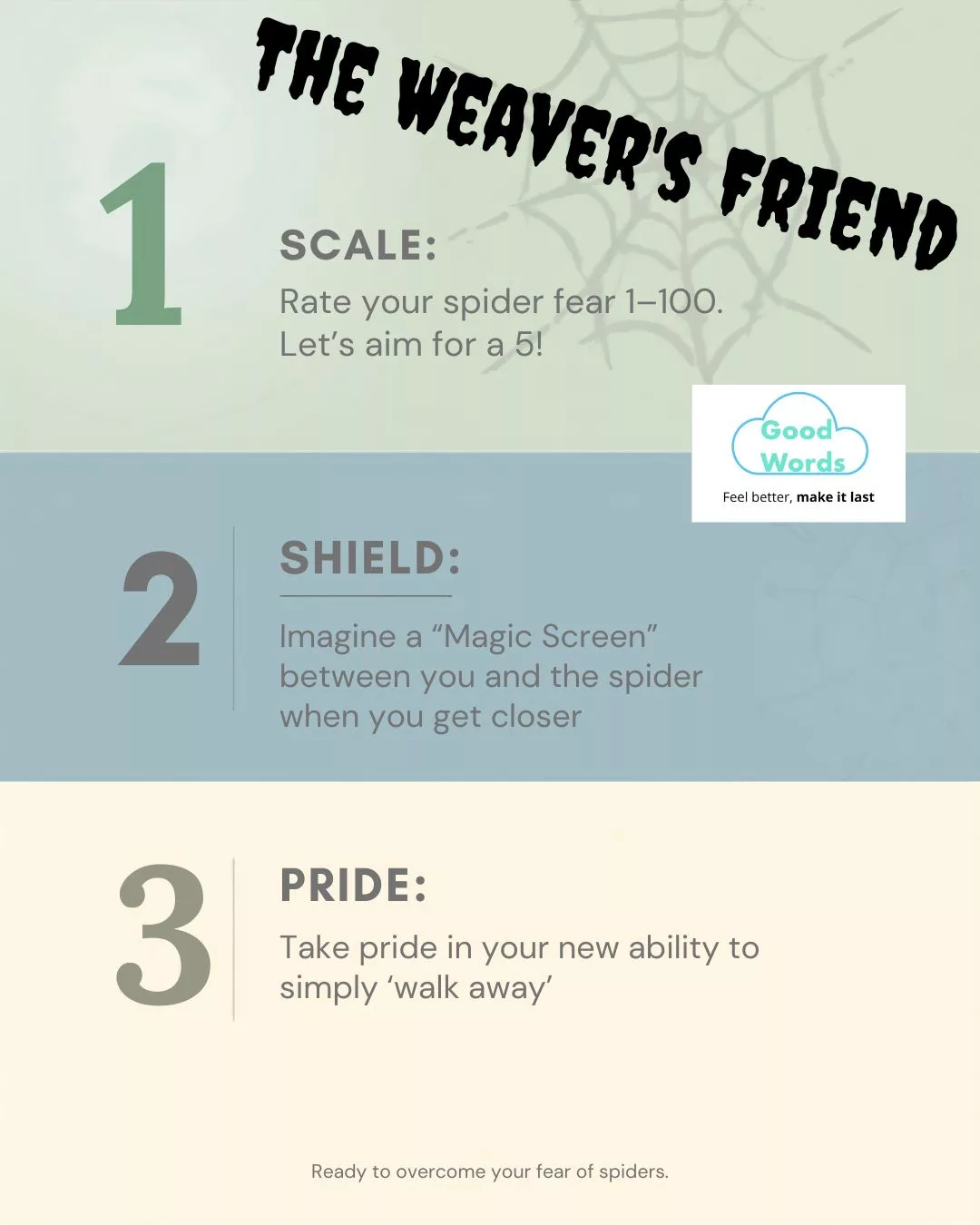
A spider is just a tiny “Eight-Legged Weaver” who is more scared of your giant shoes than you are of him. We can help your “Internal Robot” see that he is a very small neighbour who just wants to catch flies.
Symptoms: Rapid pulse, screaming, fear, grind and “paralysis” (Limb Rigidity) when seeing a web.
Suggestion to Resolve Arachnophobia: “Parts Therapy.” Talk to the “Protective Part” of your mind that is trying to keep you safe from spiders and thank it for its help, then ask it to find a “calmer way” to protect you.
Scientific Context: Stephen Williams’ “Elephant Chart” shows that too much pressure makes the “engine” freeze. Arachnophobia is a “Strain” response; we use Desensitization to move back to a healthy “Stretch”.

Why this happens
The physiological intensity of arachnophobia can be understood through Stephen Williams’ illustrates how excessive pressure makes the human “engine” freeze. When an individual experiences overwhelming stress or a perceived threat, the body moves past a state of productive alertness and enters severe distress. Arachnophobia is fundamentally a “Strain” response, where the nervous system is pushed far beyond its healthy “Stretch” boundary.
Historically, human survival relied on swift protective instincts around potential hazards. Over time, your subconscious “Internal Robot” may misinterpret a harmless garden spider as an existential danger. When this learned pattern is triggered, the nervous system floods the body with adrenaline, causing limb rigidity, a pounding heart, and heightened anxiety. Rather than reflecting a lack of willpower, this reaction is simply an overactive safety mechanism attempting to shield you from harm.
How to fix it
To resolve arachnophobia effectively, we use a structured therapeutic approach known as “Parts Therapy.” In session, we talk to the “Protective Part” of your mind that is trying to keep you safe from spiders and thank it for its help, then ask it to find a “calmer way” to protect you. By acknowledging the protective intent of this subconscious part rather than fighting against it, we relieve the internal friction that fuels anxiety.
Your 1-2-3 quick guide
- Acknowledge the protective response and thank your mind for safety
- Reframe the spider as a small neighbour catching unwanted flies
- Practise calm breathing to move your nervous system into stretch
Hypnotherapy FAQ
What is clinical hypnotherapy and how does it work?
Clinical hypnotherapy is an established therapeutic practice that uses focused relaxation to access the subconscious mind. In this state, an accredited practitioner helps you reframe unhelpful automatic responses, release irrational fears, and establish healthier thought patterns.
Will I remain in control during a hypnotherapy session?
Yes, you remain fully conscious, aware, and in complete control throughout the session. Hypnosis is not a state of mind control; it is simply a state of guided relaxation where you choose to accept positive, beneficial suggestions.
How many sessions are usually needed to address arachnophobia?
Most clients observe significant improvements within three to six sessions. The total number of consultations varies based on individual needs, previous experiences, and how quickly your subconscious adapts to new calm responses.
Can hypnotherapy help with issues other than spider phobias?
Yes, clinical hypnotherapy effectively addresses a wide range of concerns including general anxiety, stage fright, chronic stress, pain management, weight management, and sleep difficulties by retraining automatic mental and physical habits.
Are online hypnotherapy sessions as effective as in-person appointments?
Online hypnotherapy sessions are equally effective because hypnosis relies on listening and internal mental focus. Clients across Ireland can experience deep relaxation and positive therapeutic outcomes from the comfort of their own home.
Is hypnotherapy safe for everyone?
Hypnotherapy is a safe, gentle, and non-invasive modality. As an ICHP and EAPH accredited practitioner, Alexandre Mitellus conducts an initial assessment to ensure that hypnotherapy is suitable for your specific physical and psychological well-being.
Read more on goodwords.info
- I want to sound confident, but I end up sounding angry or shaky.
- How Hypnotherapy Helps in Addiction Recovery
Spiders make my skin crawl and my heart stop
00:00 / 00:00
How was this session?

